
Low Power Magnetic Levitation: Why Coils Decide Uptime and Cost
Low power magnetic levitation sounds like a laboratory achievement. In a retail display it is a running cost, a heat budget and a service interval, all measured on the same coil.
A unit that floats on 2 W behaves very differently from one that needs 6 W, even when both look identical in a showroom. The difference appears on the electricity bill and in the base temperature.
This article converts the phrase into three numbers a buyer can check. You will see the four power draws, a worked annual cost, and the coil measurements that decide whether a claim survives a night shift.
What Counts as Low Power Magnetic Levitation?
Low power magnetic levitation means the coil holds its rated load with the smallest practical current for a given gap. It does not mean a dim lamp, a smaller bulb or a lighter object standing in for the real product.
The honest comparison is always at identical gap and identical load. UN 350 g lamp floating at 15 mm is a specific case, and a 2 kg display at 20 mm is a different one.
Without those two anchors, a watt figure is marketing. With them, it becomes an engineering statement you can reproduce on a bench with a power meter.
Which Four Power Draws Make Up the Real Budget?
Every levitating display draws power in four separate phases. Buyers who only look at the holding figure miss the other three, and the other three decide the annual total.
Standby covers the controller, the sensor and the wireless link while nothing floats. Holding power keeps the field stable, and it is the only figure most catalogues publish.
Illumination is often the largest single draw, because an LED driver and a bright source can exceed the levitation circuit. Peak attraction adds a short burst at start-up and after a contact event.
Why Do Coil Losses Dominate Continuous Operation?
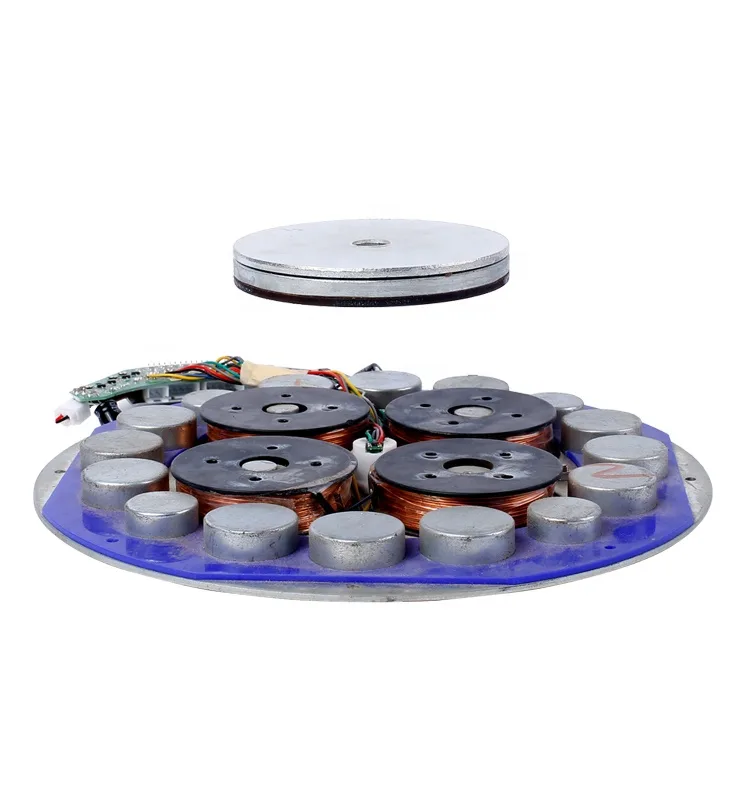
Resistive loss in the winding rises with the square of the current. Doubling holding current quadruples the heat in the copper, which is why a small gap change can double the temperature rise.
Drive topology matters just as much. A resonant tank transfers energy to the load with far less loss than a linear driver that burns the difference as heat inside a transistor.
Wire gauge, fill factor and winding length set the resistance a designer cannot avoid. A well-filled coil with short mean turn length loses noticeably less than a loose winding of the same diameter.
Control bandwidth completes the picture. A loop that reacts slowly must hold extra current as margin, so an unstable design pays for its instability every hour of every day.
How Much Does Continuous Levitation Cost per Unit per Year?
Here is a worked example with stated assumptions, so you can replace them with your own numbers. The unit holds 350 g at 15 MM, runs 24 heures, and lights for 12 hours each day.
Standby is 0.4 W, holding is 2.1 W, illumination is 3.2 W, and the start-up burst averages out below 0.1 W across a day. Electricity is priced at 0.20 USD per kWh.
Holding contributes 50.4 Wh, lighting contributes 38.4 Wh, and standby contributes 9.6 Wh. The daily total is 98.4 Wh, which becomes 35.9 kWh across a full year.
At 0.20 USD per kWh, one unit costs about 7.18 USD a year to run. A hundred units in a chain cost roughly 718 USD, and the illumination share is close to 39% of that total.
This is why low power claims deserve a second question. Saving 1 W of holding current is worth about 8.8 kWh a year per unit, and the same 1 W removed from lighting saves 4.4 kWh.
Goodwell quotes a 15% reduction in holding power against a conventionally wound coil at the same gap and load, and states that baseline in the product data. The comparison only means something with both anchors attached.
What Heat and Lifetime Penalties Follow an Efficient Coil?
Every watt saved at the coil also leaves the base as one less watt of heat. A cooler winding keeps its enamel and its former in better condition over months of continuous duty.
Temperature also shifts the copper resistance, which shifts the resonant point, which the controller must then track. A hot base is a control problem before it becomes a reliability problem.
LED lifetime follows the same logic. A source running 15 °C cooler at the junction keeps far more of its initial output after a year of twelve-hour days.
How Do Buyers Verify Low Power Claims Before Ordering?
Three measurements settle most arguments, and none of them requires a laboratory. A plug-in power meter, a thermal probe and a stopwatch cover the whole protocol.
V1: Standby and Holding Baseline
Measure the unit with the lamp removed from the field, then with it floating at the rated gap. Record both figures after five minutes of stable operation at 25 °C ambient.
A credible datasheet matches the measured holding value within 10% and states whether the figure includes the driver and the sensor. Ask for that scope in writing before you compare two units.
V2: Twenty-Four Hour Energy Log
Log watt-hours across a full day with the lighting schedule your store will actually use. Compare the total with the sum of the four phases in the supplier datasheet.
A daily total above 120 Wh for a 350 g display at 15 mm deserves an explanation. The model above lands near 98 Wh under the same assumptions, so the gap points to either lighting or a wasteful driver.
V3: Base Temperature at Steady State
Run eight hours at 25 °C ambient and record the base centre every 30 minutes. A plateau within 18 °C of ambient supports a claim of continuous retail duty without active cooling.
A unit still climbing after six hours has not reached steady state. Its annual energy figure is probably optimistic as well, because the hottest hour has not yet arrived.
V4: Gap Stability Under Load Change
Add 50 g, then remove it, and watch the current reading on the meter. A stable design returns to its baseline draw within three seconds, without a sustained spike.
Repeated spikes mean the loop is chasing the load. Chasing costs energy every time a visitor touches the display, and the wasted watt-hours accumulate across a full trading day.
Which Applications Benefit Most From a Low Power Coil?
Continuous duty is the dividing line. A unit switched on for a two-hour event barely repays an efficient coil, while a window display running all year repays it quickly.
Cosmetics counters and shoe walls are the clearest cases, because both run long hours and both need bright illumination near the product. Notre cosmetics display case study shows how the two loads combine.
Battery-backed pop-up stands form the second case. Lower holding current directly extends runtime, so a coil upgrade can replace a larger battery rather than add one.
What Should a Supplier Audit Checklist Include?
Send these eight items before the first sample ships. Written answers separate a supplier who measured from one who estimated, and the difference shows up in the first week of operation.
- Holding power in watts, with the gap and the load mass stated beside it.
- Standby power, and whether the sensor and driver are included in that figure.
- Illumination power at the brightness level the store will use.
- Measured twenty-four hour energy total in watt-hours.
- Base surface temperature at 25 °C ambient after eight hours.
- Drive topology, whether resonant or linear, and the resulting efficiency band.
- Coil resistance and the winding specification used in production.
- Replacement part numbers for the coil and the driver board.
Each line converts a slogan into something a power meter can confirm. That is the whole point of an audit, and it takes less time than a second round of samples.
Module-level data is easier to compare than finished-product data. Notre levitation module range publishes both figures for each load class, including the test conditions behind them.
For an RFQ that collects these values in one pass, utiliser le module supplier RFQ template. It lists the eight fields above so a supplier can answer them in a single return.
Where Does Efficiency Sit Against Price and Size?
An efficient coil usually costs more copper and a better driver, and both raise the unit price. In low power magnetic levitation the saving arrives monthly, so the payback period depends on duty cycle rather than on volume.
Size is the second trade. A larger coil diameter holds the same load at lower current, but it forces a wider base and a heavier plinth in the store fixture.
Buyers usually settle this with a simple rule. Match the coil to the duty cycle first, then choose the smallest base that keeps the thermal margin intact.
Le US Department of Energy efficiency resources explain how duty cycle assumptions change measured savings. That framing applies to display fixtures as much as to household appliances.
Frequently Asked Questions About Low Power Magnetic Levitation
Does lower power mean a weaker hold?
Non, when the comparison happens at the same gap and load. A resonant driver reaches the same field strength with less current, so the hold stays identical while the loss falls.
How many watts should a display lamp use?
Ask for holding and illumination separately, then add them. A low power magnetic levitation display of 350 g at 15 mm commonly sits near 2 W holding, with lighting often the larger of the two figures.
Can a low power coil run from a battery?
Oui, and runtime follows the holding figure directly. Halving holding current roughly doubles battery hours, provided the start-up burst stays inside the pack rating and the ambient stays mild.
Why do two similar lamps show different wattage?
Écart, load mass and lighting level usually differ, even when the bases look alike. Ask for all three conditions before comparing the two numbers side by side.
Is low power the same as low heat?
Usually, but the path matters. A linear driver can burn extra energy away from the coil, so the winding stays cool while the enclosure still runs warm.
More baseline questions are collected in our product FAQ. It also explains how gap and load class are quoted for custom builds and prototype runs.
Send Your Duty Cycle for a Power Estimate
Send the load mass, the gap and the daily hours your store will run. Our engineers will return an estimated watt-hour figure for the module that fits the application.
WhatsApp: +86 134 5018 0012. Send the load mass, the gap and the daily hours in one message, and the reply will include an estimated watt-hour figure.
Email also works, at [email protected]. Attach the store layout if the display will share a circuit with refrigeration, and the estimate will account for voltage dips.