How Does Magnetic Levitation Work? The Science Behind Floating Products
The Core Principle: Electromagnetic Suspension (EMS)
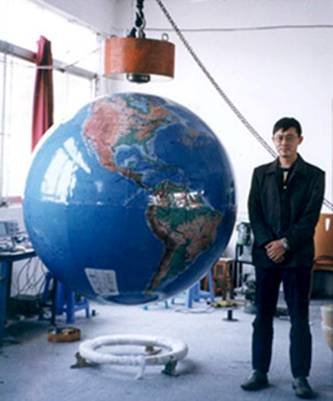
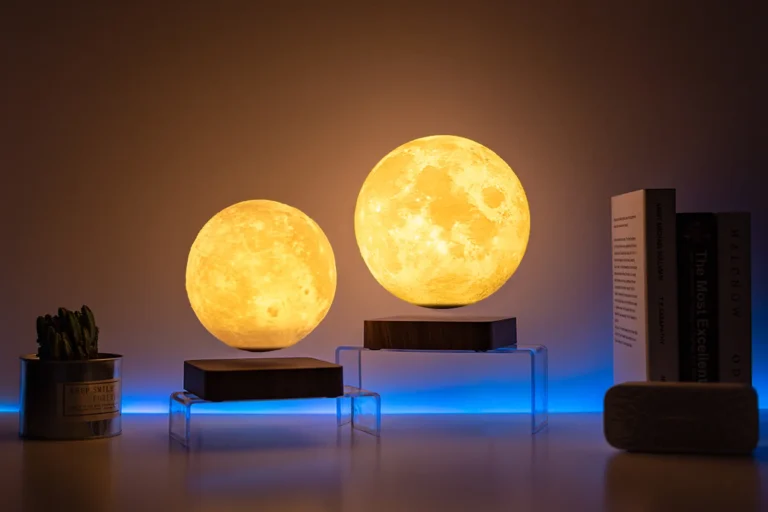
Have you ever looked at a floating moon lamp or a levitating display stand and wondered, “How is that even possible?” It looks like magic, but it is actually a brilliant application of physics and advanced engineering. In this article, we will break down the science behind magnetic levitation and explain how Goodwell’s products achieve such stable, gravity-defying effects.
At its most basic level, magnetic levitation (maglev) works by using magnetic fields to counteract the gravitational pull of the Earth. However, simply placing two magnets with the same poles facing each other is not enough. According to Earnshaw’s Theorem, it is impossible to achieve stable levitation using only static (permanent) magnets. The object will inevitably flip over or slide off to the side.
To solve this, modern levitating products use a combination of permanent magnets and electromagnets controlled by a micro-computer. This system is known as Electromagnetic Suspension (EMS).
The Three Key Components
1. The Base (The Brain and Muscle)
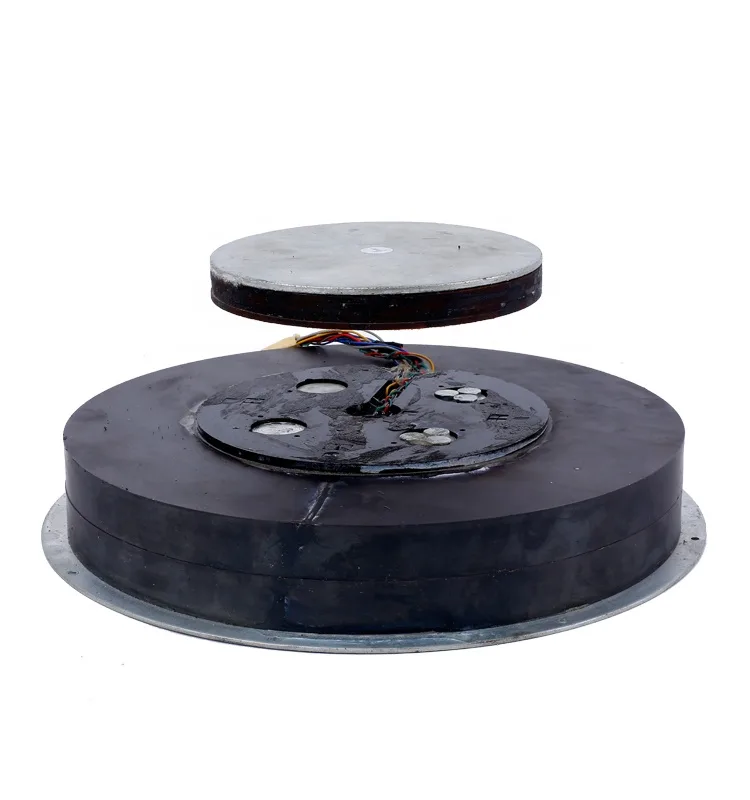
The base of the product contains a ring of powerful electromagnets surrounding a central Hall-effect sensor. The electromagnets generate a magnetic field that pushes against the permanent magnet inside the floating object.
2. The Floating Object (The Payload)
Inside the floating object (like the moon lamp or the display platform) is a strong Neodymium (NdFeB) permanent magnet. This magnet interacts with the magnetic field generated by the base.
3. The Microcontroller and Sensors (The Balancer)
This is where the “magic” happens. The Hall-effect sensors in the base constantly monitor the exact position of the floating magnet—measuring its distance and angle thousands of times per second. If the floating object starts to drift even a fraction of a millimeter, the microcontroller instantly adjusts the electrical current to push the object back to center. This continuous, high-speed micro-adjustment is what keeps the object perfectly stable in mid-air.
Wireless Power Transmission: Lighting Up the Void
You might also wonder how a floating light bulb or moon lamp lights up without any wires or batteries. The answer is Magnetic Induction. Inside the base, there is a primary copper coil that generates a high-frequency alternating magnetic field. Inside the floating object, there is a secondary receiver coil. When the object is placed in the magnetic field, the field induces an electrical current in the receiver coil, which powers the LEDs. This is the exact same technology used in wireless smartphone chargers, optimized to work across a 10-20mm air gap.
Safety First: Smart Power-Off Protection
A common concern is: “What happens if the power goes out? Will my floating object crash and break?” Goodwell engineers have solved this with Smart Power-Off Protection. When the power is suddenly cut off, the electromagnets stop repelling, and the permanent magnets instantly pull the floating object securely down to the base. It will not fall off the table.
Conclusion
Magnetic levitation is a perfect blend of physics, electronics, and design. By mastering the delicate balance of electromagnetic fields and high-speed sensor feedback, Goodwell creates products that are not only visually stunning but also incredibly stable and safe for everyday use. Whether you are looking for a unique piece of home decor or an eye-catching retail display, understanding the technology behind it makes the experience even more fascinating.