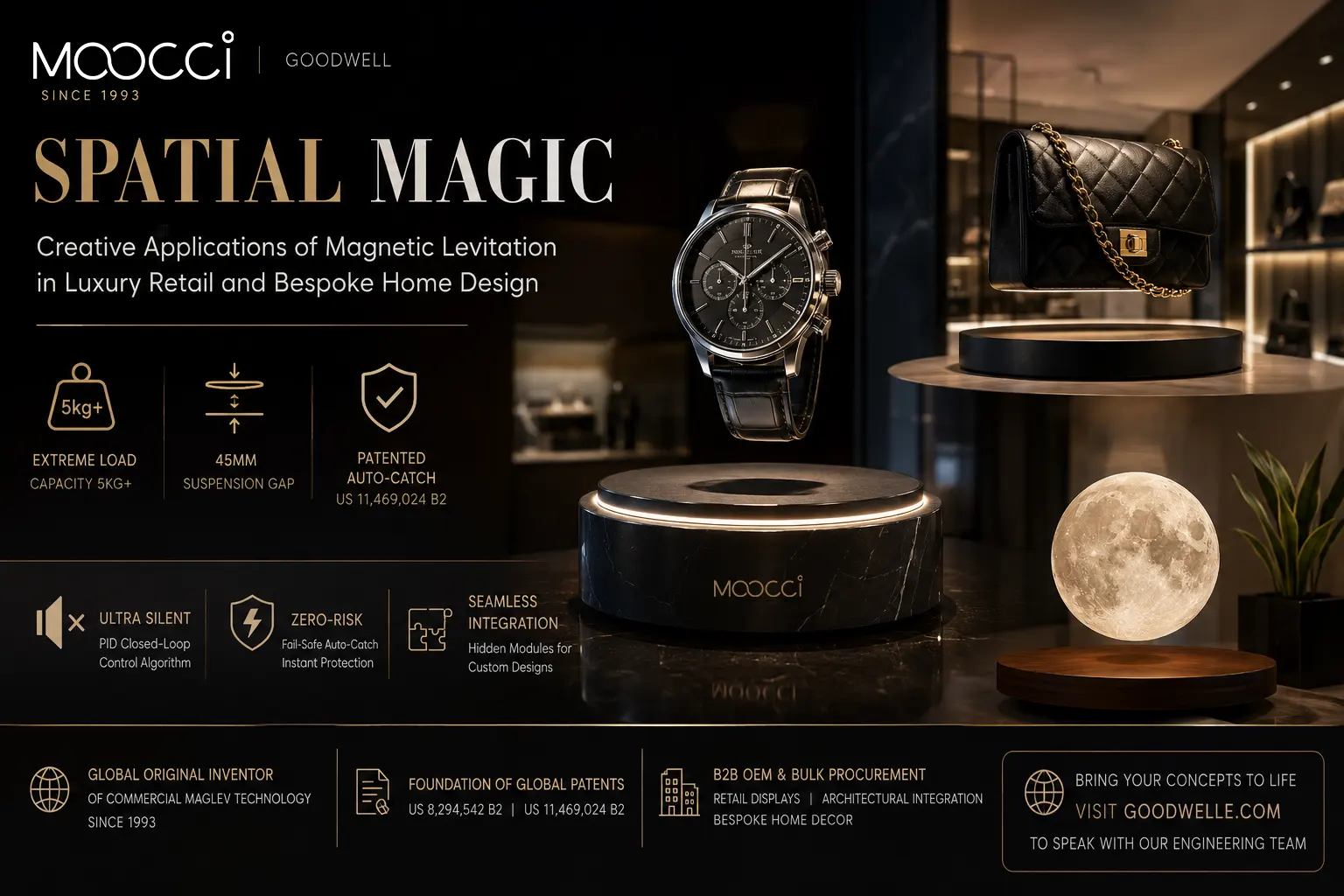
How to Design a Magnetic Levitation Cosmetics Display Without Blocking Visibility
A magnetic levitation display for cosmetics must float a lipstick, serum bottle, or perfume vessel while keeping the label, the texture, and the product finish visible to the customer. Unlike footwear, cosmetic packaging is narrow, tall, and often glass, geometry that tips, spins unpredictably, and blocks its own branding if the display is not designed around the visible surface from day one. This guide covers center-of-gravity control, label-facing orientation, управление теплом, and safe-landing requirements for beauty retail.
The commercial objective is simple: the customer reads the product, sees the shade or texture, and associates the display with brand quality. Any engineering choice that hides the front label, creates glare, or lets the bottle wobble defeats the point of levitation and wastes the visual investment.
1. Why Cosmetics Packaging Defies Standard Floating Displays
Mascara tubes weigh 30-60 g with a tall, narrow body; glass perfume bottles can exceed 300 g with heavy bases; compact cases sit flat but present a shallow center of pressure. Each geometry demands a different pad, rotation rate, and load rating rather than a universal one-size platform.
Under center-of-gravity mapping, a tall 50 g lipstick has its mass concentrated near the cap, offset from the contact axis by 10-15 мм. Left uncorrected, that offset produces continuous tilt. Our design rule: any product whose center of gravity sits more than 10 mm above and 5 mm off the magnetic centerline goes through a custom pad and cradle review before tooling.
2. Keeping the Label Facing the Customer
The single most common mistake in cosmetics levitation is treating the platform as generic and letting the bottle spin freely. Free rotation means the customer sees the back of the package half the time, which wastes the brand label design and the shelf impact the display was purchased to create.
We specify controlled rotation at one turn every 20-30 seconds, or a fixed 120 degree presentation angle for hero SKUs, so the front label stays in the customer field of view for most of the cycle. The RFQ should state the required label-facing window rather than asking for a floating bottle.
| Cosmetics Format | Typical Mass | Geometry Challenge | Display Solution |
|---|---|---|---|
| Lipstick / mascara tube | 30-80 глин | Tall, narrow, light | Low-pad cradle, slow rotation |
| Glass serum / dropper bottle | 100-300 глин | Heavy base, fragile | Larger base, gap at lower end |
| Perfume bottle | 200-500 глин | Variable silhouette, high value | Custom cradle, power-loss landing required |
| Compact / cushion case | 50-150 глин | Flat, low CoG | Standard pad, fine for hero display |
For hero SKU windows where the brand wants the label locked to the customer rather than rotating, we can fix the vessel at a 120 degree presentation angle. This trades the kinetic motion for a static premium look and works well behind glass where rotation wobble is magnified. The choice between slow rotation and fixed angle should be made against the store viewing distance, not preference.
3. Lighting and Heat Around Floating Beauty Products
Retail display lighting adds localized heat on top of an already energized coil. A focused LED track on a floating serum bottle can raise coil temperature faster than the platform thermal design assumes, shortening service life and triggering thermal protection.
Under continuous 24/7 validation with the specified retail lighting on, coil temperature rise should be documented and kept within the driver rated envelope. Ask the supplier for the measured rise with lighting operating, not ambient bench numbers. For illuminated floating elements, evaluate wireless induction powering separately for thermal coupling between the receive coil and the product.
4. Стекло, Valuables, and Power-Loss Protection
Perfume glass and premium skincare bottles are both valuable and breakable. The failure mode that matters is not will it float but what happens when power drops mid-trading-hours, because a dropped bottle means both product loss and a safety incident on the counter.
Specify automatic safe landing on power failure: the vessel settles onto its magnetic seat rather than falling. Request the test record showing the landing behavior with your actual bottle mass and center of gravity. For glass formats, ask whether a cushion insert or a wider catch tray is included. More detail on the underlying mechanism is in our power outage protection guide.
5. Материал, Finish, and Enclosure Considerations
The base finish matters as much as the floating vessel itself. A brushed metal or matte black base photographs cleanly under retail lighting and does not compete with the product, while a glossy reflective base creates glare that obscures the bottle label. We recommend specifying the base material in the RFQ, not choosing it after prototyping.
For glass vitrine integration, the base needs clearance for its power cable and any wireless induction receive coil. Plan for a 10-15 mm cable channel behind the plinth, and confirm the vitrine interior height leaves 80-120 mm above the floating bottle so the vessel does not contact the glass when it lands on power failure.
Under enclosure thermal testing (sealed acrylic box, 30 W LED overhead, 24 hours continuous), we record base surface temperature and internal air temperature separately. If internal air exceeds 45 C, the enclosure needs additional ventilation. Request this thermal data alongside the landing test, because glass cabinets amplify heat more than open shelves do.
Can a cosmetics display be reconfigured for a new product shape mid-season?
Да, if the cradle and pad are designed as interchangeable parts. We build swap-out cradles for seasonal SKU rotations, but the base itself must be sized for the heaviest product in the rotation. Confirm interchangeability in the mechanical drawing, not in the purchase order.
How does rotation speed affect label readability?
One revolution every 20-30 seconds gives the customer roughly 6-8 seconds on the front label per pass. Faster than 15 seconds per turn and the label becomes unreadable; slower than 40 seconds and the display loses kinetic appeal. We tune this window against your label size and viewing distance.
6. Supplier Audit Checklist for Cosmetics Display Programs
- Provide your exact product dimensions, масса, and center-of-gravity sketch before prototyping.
- Require a custom pad and cradle quote, not a universal one-size platform.
- Request the measured levitation gap and rotation period at your product actual mass.
- Confirm the label-facing angle and rotation window the platform delivers.
- Obtain the power-failure safe-landing test video with your bottle type mounted.
- Verify thermal testing was performed with retail lighting operating, not in ambient conditions.
- Review the catch tray or cushion design for glass and high-value formats.
- Check IP and patent documentation for the bottom-push control architecture.
7. Часто задаваемые вопросы
Can a magnetic levitation cosmetics display rotate slowly enough to keep the label facing customers?
Да. We specify one revolution every 20-30 seconds, or a fixed hero angle for key SKUs. Free spin is a configuration choice, not a technical requirement.
What happens to a glass perfume bottle if the store power cuts out?
The bottom-push system applies safe landing on power failure, seating the bottle magnetically onto its pad. We recommend requesting the test video with your exact bottle mass before ordering.
How heavy a serum bottle can the platform float?
Our maglev modules cover 100 г к 2,000 g+ as a customized range; the correct rating depends on center of gravity and eccentricity, not the headline number. See our load capacity guide и display stand specifications guide.
Does the floating bottle need batteries or wires?
Нет. Any illuminated element uses wireless induction powering; the levitation platform itself makes no physical contact with the floating vessel.
When a cosmetics brand rolls the display out across 50 или 500 магазины, unit-to-unit consistency becomes a technical issue rather than a showroom concern. Every base should hold the same levitation gap within plus or minus 2 мм, rotate at the same rate, and land on power failure with the same sound and timing. We build these tolerances into the production spec and provide factory test reports per unit, not per batch.
Request a pilot run of 5-10 units before full rollout. Measure gap, rotation period, and landing behavior at your central merchandising office, then approve the production run against that baseline. This catches control-loop drift or coil variation that a single sample will never reveal, and it protects the brand from a store where one unit wobbles while its neighbor does not.
Design Your Cosmetics Display with Our Engineering Team
Zhaoqing Youjia Electronic (мооччи / Гудвел) has built bottom-push magnetic levitation products since 1993, operates a 27,000 m2 factory, and holds 100+ patents across China, the US, Европа, и Япония. We offer FREE DESIGN prototyping for beauty and luxury retail programs, from pad geometry to retail enclosure. Browse our floating display product range и patent and certificate record.
Send bottle samples or RFQ drawings to [email protected], submit your brief on our contact page, or message us on WhatsApp (+86 134 5018 0012).