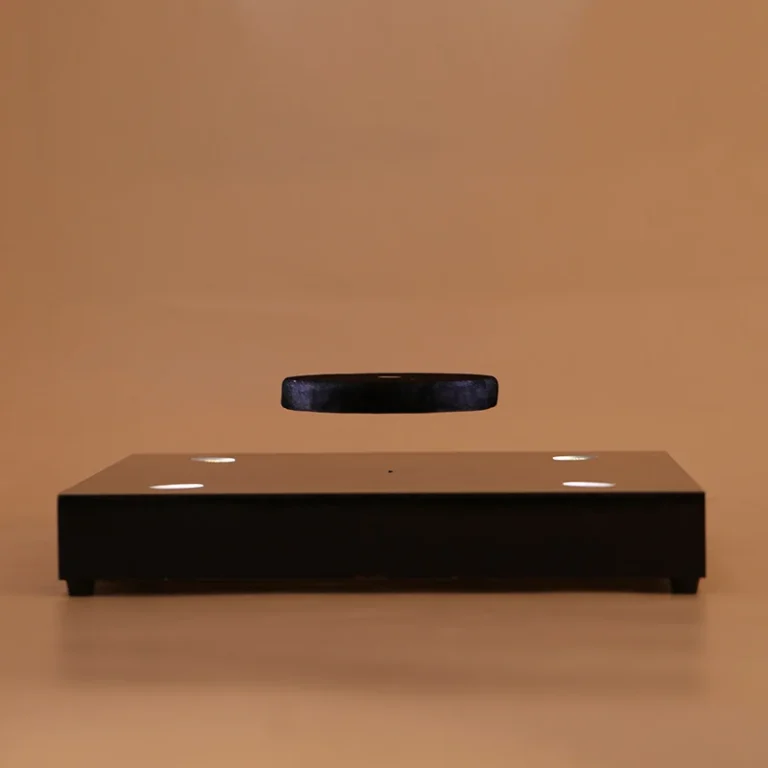

Magnetic Levitation Module Technical Specification: 9 Fields a Datasheet Must State
一个 magnetic levitation module technical specification is usually one page of numbers, and most of those numbers are printed without the conditions that make them true. A buyer then tools a housing around a gap figure that only holds at no load, and the mismatch surfaces at the prototype stage.
We build these modules and we read competitor documents the same way our customers do. This guide lists the nine fields a magnetic levitation module technical specification has to state, and what to request when a supplier leaves one out.
What Does a Magnetic Levitation Module Technical Specification Have to Cover?
A module specification defines the electrical, mechanical and protection limits of a base unit that suspends a separate body without contact. When one of those three groups is missing, the document is a product sheet rather than a specification.
Integrators need three answers from the same page: how much the module can hold, what it takes to hold it, and what it does when the supply disappears. The fields interact, so a single headline figure rarely survives testing.
场地 1 和 2: Rated Load and Levitation Gap Belong Together
Load and gap are not independent settings. Our published module family covers 100 克至 2,000 g with levitation gaps from 15 毫米至 80 mm by model, and compact units hold the 12 到 20 mm band at rated load.
A specification that prints a gap without the load at which it was measured invites a design error. Ask for a load-gap table rather than a single number, compare it with the gap design variables that move the figure, then read the pair at your own payload.
| Payload at the module | Typical gap behaviour | What the buyer must confirm |
|---|---|---|
| 25% of rated load | Gap close to the published maximum | Housing clearance above the floating body |
| 50% of rated load | Gap shortens, control still comfortable | Coil current and base temperature at duty cycle |
| 100% of rated load | Shortest usable gap, least disturbance margin | Protection timing at that mass, plus fixture tolerance |
The sequence we give customers is fixed: choose the payload first, read the gap at that payload second, and check the remaining housing clearance last. Reversing it produces a fixture that cannot be assembled.
Tolerance belongs next to the pair. A gap quoted as 20 mm without a band leaves the fixture designer guessing whether 19 mm is a failure, and assembly teams resolve that guess differently on every shift.
We state the measurement point as well, because gap read at the centre differs from gap read at the edge of a wide body. A magnetic levitation module technical specification that omits the point is only half a field.
Fixture design inherits the same pairing. A magnetic levitation module technical specification that fixes the gap but leaves the payload open will be read at the top of its range, and every unit built afterwards carries the same optimistic assumption.
场地 3 和 4: Center of Gravity Envelope and Offset Moment
The center of gravity field states where mass may sit relative to the module axis. A capsule and a boot can share a mass and behave nothing alike, because the restoring torque sees geometry rather than weight.
Offset moment is mass multiplied by horizontal distance from the axis. Once it passes the torque the loop can generate, the body drifts outward, the controller saturates and levitation collapses.
Our engineering team asks every customer for mass, centre of gravity in three axes and a drawing of the body. With those three inputs a module can be selected on paper; without them, selection is a guess, which is why we publish a load capacity measurement method.

场地 5 和 6: Input Power, Current Draw and Thermal Rise
Power fields in a magnetic levitation module technical specification should give the input voltage range, current at rated load and the temperature rise of the coil stack after a defined running period. Those three values decide whether a closed housing overheats.
Our low-power coil work targets 15% lower draw against the conventional driver baseline. The figure only means something when the comparison method travels with it, so we send the method rather than the percentage alone.
A retail display runs for a trading day and sometimes longer. Ask for a temperature curve at the ambient your fixture will actually see, not at a laboratory 22 ℃.
场地 7: Power-Loss Behaviour and Recovery
This field decides whether a display destroys its payload during a brownout. A proper entry describes detection, the landing action, the time to land and the state the module returns to when power comes back.
We design the module to pull the body onto the base when the supply fails, so the object lands instead of free-falling. The response is quoted in milliseconds under a defined condition and re-verified at the customer’s payload.
A brownout and a full outage are different events. The document should say how the module behaves when the input sags below the regulator threshold without disappearing, because that condition repeats in buildings with shared circuits.
Recovery deserves its own sentence in the document. A module that lands safely but needs a manual restart will empty a shop floor of staff time, so the specification should state whether the loop re-engages on its own.
When a supplier answers this field with the word safe and nothing else, the field has not been specified. Treat it as missing and request the test record.
场地 8 和 9: Interface, Connector and Environmental Limits
Interface fields inside a magnetic levitation module technical specification cover connector type, pinout, control signals and the mounting pattern. These decide whether your housing is tooled once or twice, so they belong in the specification and not in a later email.
Environmental limits should state the ambient range and the ingress protection of the base, with the standard the rating was assessed against. IEC 60529 defines how an IP code is composed, and a claim such as waterproof does not map onto it.
If the module will sit in a shop window or a humid store, the IP level and the condensation path belong on the page. A rating quoted without a test method is a marketing statement, not a limit you can design to.
Which Fields Change When the Payload Is a Retail Product?
Retail payloads bring two extra requirements into the same document. The first is a visible gap that suits the brand, and the second is a base that can be cleaned without disturbing the coil.
A magnetic levitation module technical specification written for retail adds a gap figure chosen for effect as well as stability. A shoe wants a taller visible gap than a bottle, and that taller gap usually means a lighter payload or a different magnet ring.
Cleaning is a real specification item. A base that collects dust around the coil loses gap consistency over a season, so the enclosure and the coil window should be described in the same drawing set.
How to Audit a Magnetic Levitation Module Technical Specification
Read the document backwards. Start at the protection field, move to the thermal field, then to the load-gap pair, and mark every figure that carries no condition.
Send that list to the supplier as a technical query. A written answer with test conditions is worth more than a second datasheet with larger numbers on it.
Units deserve the same attention. Values written to mixed conventions invite tolerance errors, 和 NIST SP 811 sets out how SI values and significant figures should be expressed in a technical document.

Treat the list below as the attachment set for a magnetic levitation module technical specification. Each item answers one of the nine fields, and together they replace a follow-up email chain with a document you can file and quote.
供应商审核清单: 5 Documents to Request With the Specification
- Load-gap curve 在 25%, 50% 和 100% of rated load, signed by the engineer who ran it.
- Center of gravity envelope drawing with the allowable radial offset in millimetres.
- Coil temperature curve over a stated running period at a stated ambient temperature.
- Power-loss test record giving detection, landing time and the payload used in the test.
- Interface drawing with connector, pinout and mounting holes under revision control.
常见问题解答
Can I use the published gap figure for my own object?
Only at the payload it was measured at. Our gaps range from 15 毫米至 80 mm by model, and a compact module sits at 12 到 20 mm at rated load, so ask for the pair in the magnetic levitation module technical specification before designing the fixture.
Does a higher load rating mean a better module?
不. A higher rating usually means a shorter gap and a smaller disturbance margin. The useful comparison is the gap-load pair at your working mass, not the maximum printed on the front page.
How much does center of gravity matter for a wide object?
A wide or top-heavy body converts a small offset into a large moment. We ask for the three-axis centre of gravity and a drawing, because a mass alone will not tell the controller what it has to hold.
What happens if the module loses power mid-display?
The specification should state the landing action and the time to land. We design for a controlled landing onto the base, and we re-verify the timing at the payload in the fixture rather than on a bench.
Send your payload details, a drawing of the object and the gap you need at that mass to 凯西@moocci.com, or message the engineering desk on WhatsApp 于 +86 134 5018 0012. Our team replies with the parameters that are missing before any quotation is prepared, and the scope of that support is set out on our Free Design portal.