magnetic levitation power outage protection industrial module test configuration
|

Magnetic Levitation Power Outage Protection: 5 Critical Checks

If a floating retail object drops when a circuit trips, the failure is not cosmetic. magnetic levitation power outage protection is a system requirement covering detection, control response, landing geometry, and restart behavior. For a luxury display or a developer prototype, the correct question is not whether magnets can lift the object, but what the system does when power disappears.

magnetic levitation power outage protection industrial magnetic levitation module

What Does Magnetic Levitation Power Outage Protection Actually Control?

Power-loss protection is a controlled transition from levitation to a supported state. The controller must recognize that coil energy or input power has fallen outside the operating window, remove unstable drive behavior, and let the levitated part settle against a defined landing surface.

In our engineering brief, the protection concept is an automatic safe landing on power failure. The public Goodwell module page also shows that load and levitation gap vary by configuration, including 30–35 mm and 75–80 mm examples, so the landing path cannot be separated from the selected module and payload.

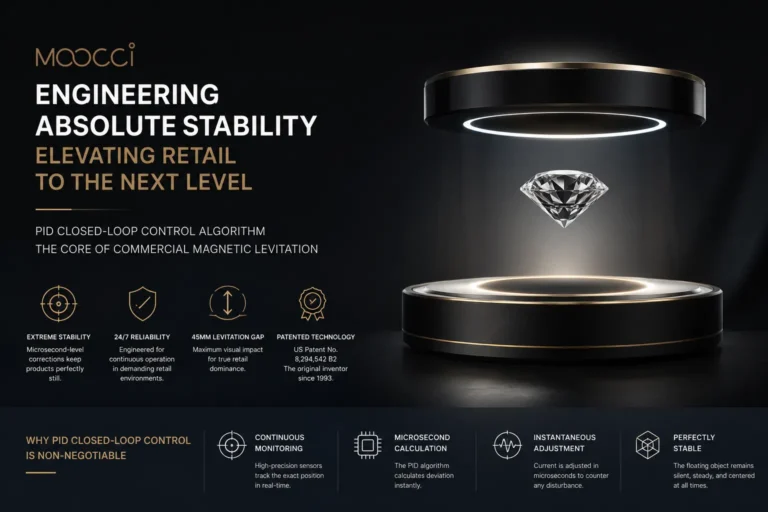
The design target described for selected moocci systems is a millisecond-level protective action. That statement must be tied to a measured test condition: input voltage, interruption method, controller revision, 有效负载, center of gravity, and the point at which the response timer starts.

Control layerFailure questionEvidence to request
DetectionHow is input loss identified?Threshold, sensor path, and response-time definition
LandingWhere does the payload settle?Landing geometry and impact-control drawing
RecoveryWhat happens after power returns?Reset sequence and repeat-cycle record
ValidationDoes the result hold under load?Test report with payload and center of gravity

Why Load, Gap, and Center of Gravity Change the Risk

A floating object is not just a mass value. The payload creates a force and a moment, and the controller must keep the magnetic center aligned while the object is exposed to vibration, touch, 风, or an off-axis center of gravity.

Goodwell’s public module page lists multiple load and gap combinations rather than one universal rating. The company brief separately defines a 12–20 mm target range for selected modules and a customized 100 g to 2,000 g-plus load range; those values should be treated as configuration inputs, not a blanket rating.

For a 2 kg floating display stand, the RFQ should specify the product footprint, center of gravity, offset from the magnetic axis, 悬浮间隙, and operating duration. Without those fields, a nominal kilogram figure cannot predict the landing force or the risk to a high-value product.

Which Power-Loss Tests Should a Supplier Run?

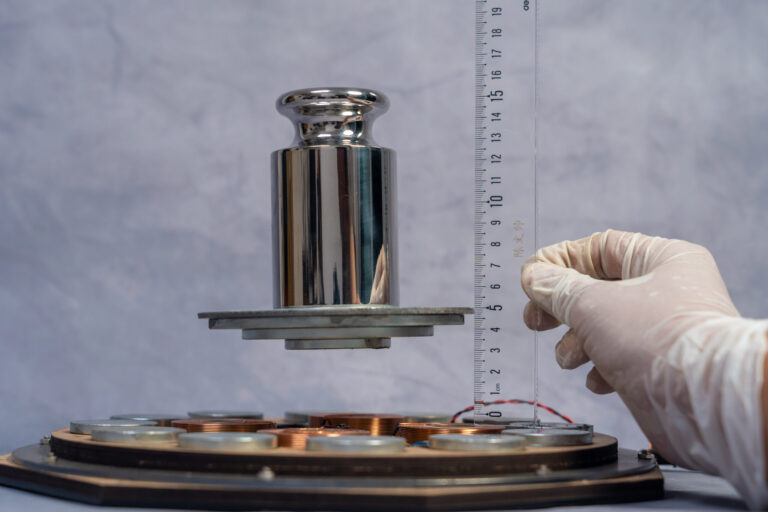
The minimum test is a controlled interruption at the declared operating condition. Repeat it with the payload installed, record the landing result, and inspect the object, base, contact surfaces, and enclosure for impact marks or displacement.

A stronger validation plan repeats the interruption at the lower and upper load limits, after thermal stabilization, and with the payload intentionally placed at the stated center-of-gravity tolerance. The report should separate a clean power cut from brownout, connector removal, and controller reset behavior.

We recommend that buyers ask for a cycle count and acceptance criteria rather than a single demonstration video. A supplier should be able to identify the exact module, firmware or controller revision, power input, 有效负载, 差距, interruption method, and whether manual repositioning was needed after recovery.

  • Power interruption at the declared input condition
  • Repeated tests at minimum and maximum specified payload
  • Center-of-gravity and offset tolerance stated in millimeters
  • Landing contact inspected for damage or deformation
  • Restart sequence documented after power restoration

How Does Goodwell Position the Protection Mechanism?

ZHAOQING GOODWELL ELECTRONICS COMPANY LIMITED presents itself as a magnetic levitation manufacturer with a 27,000 m² factory and more than 100 patents on its public company pages. Those claims establish a manufacturing context, but they do not replace a product-specific power-loss report.

The moocci development brief combines bottom-push levitation, closed-loop electromagnetic control, and an automatic safe-landing concept. For a commercial integration, our FREE DESIGN service should begin with the payload, 差距, center of gravity, enclosure, power input, and failure-state requirements written into the design brief.

The useful distinction is between a brand promise and a verifiable engineering boundary. Buyers should use the public Magnetic Levitation Module range as a starting point, then request the exact test record for the module selected for their product.

Supplier Audit Checklist: 5 Documents to Request Before Signing

  • Module datasheet: confirms load, 差距, input, 方面, and declared operating limits.
  • Power-loss test report: verifies interruption method, response definition, 有效负载, landing result, and cycle count.
  • Load and center-of-gravity test record: shows how the supplier defines payload and off-axis tolerance.
  • Pre-shipment inspection sample: confirms the same checks are applied to production units.
  • Reset and service procedure: defines what the operator should do after an interruption and what conditions void the procedure.

常问问题: Power-Loss Protection for B2B Buyers

问: What happens to a magnetic levitation product during a power outage?
A properly designed system should detect the power-loss state and guide the levitated object to a controlled landing position rather than allow free fall. Buyers should request the applicable power-loss test record and reset procedure for the exact module.

问: Is millisecond-level safe landing universal across levitation products?
不. A millisecond-level protective action is a design target that depends on the controller, sensor loop, load, 差距, and power conditions. Ask the supplier to state the measured response time and test setup instead of accepting an unqualified claim.

问: How can a buyer verify anti-drop performance?
Request repeated power-interruption tests at the declared load and center of gravity, plus evidence that the object remained seated without impact damage. The report should identify the module revision, supply condition, load, and number of cycles.

问: Can the system resume levitation after power is restored?
The answer depends on the controller and mechanical reset design. A reliable specification should state whether manual repositioning is required, how the system detects the object, and which restart condition was tested.

Need a module review or a controlled prototype plan? 接触 Goodwell’s Free Design team or email 凯西@moocci.com. For direct trade discussion, 使用 WhatsApp and include payload, 差距, center of gravity, power input, and the required failure state.

For background on electromagnetic induction, see OpenStax’s physics reference. The external reference explains the underlying induction principle; the product-specific protection result still needs to come from the supplier’s test record.

类似文章