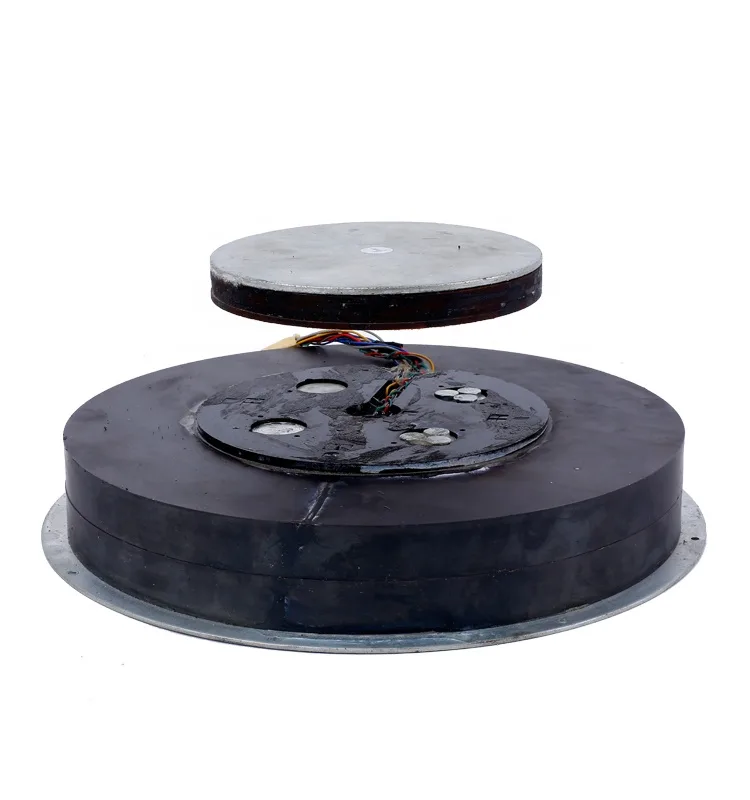
제품 개발자를 위한 자기 부상 모듈 통합 체크리스트
제품이 공급업체 비디오에 떠 있을 수 있으며 실제 인클로저가 작동할 때에도 여전히 작동하지 않을 수 있습니다., 오프셋 하중, 설치 공기 흐름이 추가됩니다.. magnetic levitation module integration is therefore an input-control problem: 개발자는 페이로드를 정의해야 합니다., 기하학, 인터페이스, 방해, 샘플을 통합 기준선으로 처리하기 전의 안전한 상태.

What Must Be Defined Before a Module Enters the Product Design?
Start with the complete assembled payload, not the decorative shell. Record mass, 치수, 무게중심, 자기 축에서 오프셋, intended levitation gap, rotation or fixed orientation, enclosure material, and the surfaces that must remain clear during operation.
Our engineering brief treats bottom-push levitation and electromagnetic closed-loop control as system elements rather than isolated features. The integration document should also state whether the product needs wireless induction powering, continuous illumination, a visual orbit, or a controlled landing during power loss.
The target gap must be tied to the selected module and load. Goodwell’s brief identifies a 12–20 mm target range for selected configurations, while public product material shows other product-specific gaps, so the exact value remains configuration-dependent and must be validated against the final payload.
| Input field | Why it changes integration | Record to request |
|---|---|---|
| Payload | Sets force and mechanical load | Mass, 치수, tolerance |
| Center of gravity | Changes axial and radial moments | Position from magnetic axis |
| 갭 | Changes force, sensing, and clearance | Loaded gap and tolerance |
| Enclosure | Changes heat path and alignment | 재료, wall, datum |
| Failure state | Defines what happens when power is lost | Landing and restart test |
How Should the Mechanical Interface Be Checked?
Fix the base-side datum before measuring any gap. A module can appear aligned on a loose bench and shift after it is mounted beneath wood, 아크릴, 유리, or a custom fixture, so the prototype should preserve the production mounting direction and the intended support structure.
Check the payload’s magnetic axis, receiver position, visual center, and clearance envelope together. If the object is asymmetric, document the orientation used for the test because a centered mass value does not describe the moment created by an offset or tall product.
During a controlled disturbance test, record displacement, recovery behavior, and contact with any guide or landing surface. If no measured result is available, mark the acceptance value as to be validated rather than converting a visual impression into a performance claim.

Which Electrical and Control Inputs Belong in the Integration File?
The electrical section should name the controller revision, 센서 경로, coil assembly, input condition, connector strategy, and any receiver used for wireless power. Do not add a voltage or wattage to the RFQ unless the selected module datasheet confirms it, because the knowledge base does not provide a universal value.
The control section should describe the measured position, the controlled axes, the disturbance to be applied, and the response criterion. A statement such as stable under disturbance is incomplete until the buyer defines the disturbance type, amplitude, duration, maximum displacement, and recovery limit.
For a lighting or display product, test the integrated thermal path after the enclosure is closed. Record the sensor and coil temperature under the declared operating condition, and label the result to be validated if the assembled prototype has not yet completed the intended runtime.
- Name the exact module and controller revision
- Record payload, 갭, 무게중심, and offset
- Define the disturbance and recovery acceptance criteria
- Check enclosure clearance and thermal path
- Test power loss, landing, reset, and restart
- Freeze the signed prototype revision before production quotation
How Do Goodwell Developers Move from Sample to Production Input?
Goodwell presents itself as a magnetic levitation manufacturer with public pages for Magnetic Levitation Module, 제품, 커스텀 케이스, and Patent & 자격증. Those pages help a developer identify the relevant product family, but they do not replace a project-specific drawing, datasheet, or signed test record.
Our FREE DESIGN workflow should begin with the payload drawing and the failure-state requirement, then map the mechanical datum, control envelope, wireless-power need, and visual objective. The developer should keep each revision linked to the sample so a later cosmetic change cannot silently change the load or alignment condition.
Use the 자기부상 모듈 제품군 for the initial hardware context, 그만큼 Custom Case page for application direction, 그리고 연락하다 / 자유로운 디자인 for the project brief. Documentation questions can be routed through the 특허 & Certificate page without assuming that a public page is a product certificate.
공급업체 감사 체크리스트: 5 서명 전 요청해야 할 서류
- Configuration datasheet: confirms module identity, 치수, gap range, load boundary, interfaces, and declared limits.
- Integration drawing: shows mounting datum, clearance, sensor or receiver position, and the mechanical landing path.
- Loaded stability test record: identifies payload, 무게중심, 오프셋, 갭, 방해, 실행 시간, and acceptance result.
- Power-loss and restart report: records landing behavior, reset steps, and repeated recovery conditions for the selected assembly.
- Prototype approval sheet: freezes the accepted mass, 기하학, appearance, thermal observations, and revision before production quotation.
자주하는 질문: Magnetic Levitation Module Integration
큐: What information should a developer provide before integrating a magnetic levitation module?
Provide payload mass and dimensions, 무게중심, 오프셋, target gap, 울로 둘러싼 땅, power interface, visual motion, 실행 시간, 그리고 필요한 실패 상태. A complete input sheet lets the supplier separate a feasible configuration from a demonstration that has not been validated.
큐: Can a module rated for one payload be transferred to another product?
아니요. The same nominal mass can create a different moment when the center of gravity, footprint, or offset changes. Request a configuration-specific test record that names the module, 유효 탑재량, 갭, 방해, 실행 시간, and acceptance criteria.
큐: What should be tested before freezing an integrated prototype?
Test loaded levitation, gap tolerance, center alignment, 방해, 열적 거동, power loss, restart, and mechanical clearance as an assembled unit. The signed result should record the exact prototype revision and identify every condition that remains to be validated.
큐: How does Goodwell support early module integration?
Goodwell describes a FREE DESIGN service for requirement clarification, structural or appearance concepts, and sample validation. Buyers should send drawings and measurable requirements through the Contact page and keep the resulting configuration record with the prototype approval file.
Send your payload drawing, center-of-gravity estimate, target gap, and failure-state requirement to Goodwell Contact / 자유로운 디자인. 이메일 [email protected] so our engineering team can identify the inputs that remain to be validated.
For the underlying physics of forces and fields, consult OpenStax Physics. The reference supplies general scientific context, while the product decision still requires a configuration-specific Goodwell test record.